


Shopping Cart
Remove All Your shopping cart is currently empty

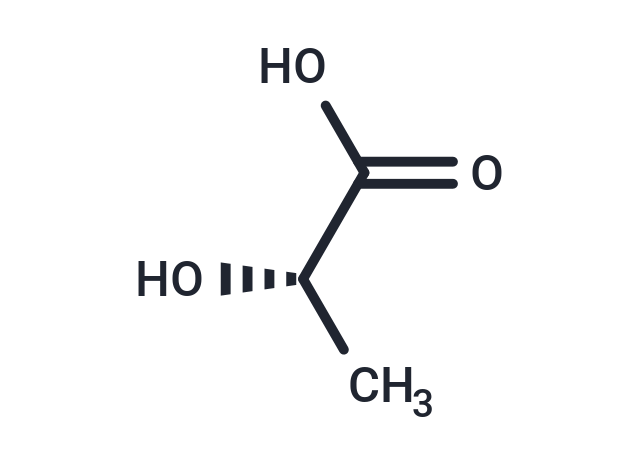
L-Lactic acid ((S)-2-Hydroxypropanoic acid) is a natural product produced by the anaerobic glycolysis of pyruvic acid. L-Lactic acid is a sensitive indicator of tissue hypoxia and can be used as a hemodynamic indicator in critically ill patients.
| Pack Size | Price | USA Warehouse | Global Warehouse | Quantity |
|---|---|---|---|---|
| 500 mg | $41 | In Stock | In Stock | |
| 1 g | $48 | In Stock | In Stock | |
| 1 mL x 10 mM (in DMSO) | $45 | In Stock | In Stock |
| Description | L-Lactic acid ((S)-2-Hydroxypropanoic acid) is a natural product produced by the anaerobic glycolysis of pyruvic acid. L-Lactic acid is a sensitive indicator of tissue hypoxia and can be used as a hemodynamic indicator in critically ill patients. |
| Targets&IC50 | LDHA:3 nM |
| In vitro | METHODS: Mouse CD4+CD25-T cells were treated with low-glucose medium containing L-Lactic acid (5-20 mM), and Teff proliferation was detected by Flow cytometry. RESULTS: L-Lactic acid had a sustained inhibitory effect on T cell proliferation, and apoptosis-independent effect. [1] METHODS: T cells were cultured in medium containing L-Lactic acid (20 mM), and ROS levels were measured using ROS and superoxide detection assay kits. RESULTS: A significant reduction in ROS and O2- production was observed in L-Lactic acid-treated T cells. [2] |
| In vivo | METHODS: To study its effect on swimming endurance, L-Lactic acid (25-50 mg/kg in 0.9% NaCl) was administered intraperitoneally to ICR mice. RESULTS: L-Lactic acid enhanced the swimming endurance of mice, and the effect was dose-dependent. [3] METHODS: To investigate the effect on endotoxemia, L-Lactic acid (80 mg/kg) was intraperitoneally injected into mice, and 20 h later, a lethal dose of LPS (25 mg/kg) was intraperitoneally injected into mice to induce infectious shock. RESULTS: L-Lactic acid significantly inhibited LPS-induced cytokine induction in mice following endotoxemia.L-Lactic acid treatment decreased glucose uptake and lactate output during LPS stimulation. [4] |
| Synonyms | L-(+)-Lactic acid, 2-HYDROXYPROPIONIC ACID, (S)-2-Hydroxypropanoic acid |
| Molecular Weight | 90.08 |
| Formula | C3H6O3 |
| Cas No. | 79-33-4 |
| Smiles | [C@@H](C(O)=O)(C)O |
| Relative Density. | 1.19 g/cm3. Temperature:25 °C.;1.2 g/cm3. Temperature:25 °C. |
| Storage | store at low temperature,keep away from direct sunlight | Powder: -20°C for 3 years | In solvent: -80°C for 1 year | Shipping with blue ice/Shipping at ambient temperature. | |||||||||||||||||||||||||||||||||||
| Solubility Information | DMSO: 262 mg/mL (2908.53 mM), Sonication is recommended.  | |||||||||||||||||||||||||||||||||||
| In Vivo Formulation | 5% DMSO+95% Saline: 2.63 mg/mL (29.2 mM), Solution. Saline: 50 mg/mL (555.06 mM), Solution. 10% DMSO+90% Saline: 5 mg/mL (55.51 mM), Solution. Please add the solvents sequentially, clarifying the solution as much as possible before adding the next one. Dissolve by heating and/or sonication if necessary. Working solution is recommended to be prepared and used immediately. The formulation provided above is for reference purposes only. In vivo formulations may vary and should be modified based on specific experimental conditions. | |||||||||||||||||||||||||||||||||||
Solution Preparation Table | ||||||||||||||||||||||||||||||||||||
DMSO
| ||||||||||||||||||||||||||||||||||||
 For example, if the intended dosage is 10 mg/kg for animals weighing 20 g , with a dosing volume of 100 μL per animal, and a total of 10 animals are to be administered, using a formulation of
  10% DMSO+ 40% PEG300+ 5% Tween 80+ 45% Saline/PBS/ddH2O , the resulting working solution concentration would be 2 mg/mL.
Dissolve 2 mg of the compound in 100 μL DMSO to obtain a stock solution at a concentration of 20 mg/mL . If the required concentration exceeds the compound's known solubility, please contact us for technical support before proceeding.
1) Add 100 μL of the DMSO stock solution to 400 μL PEG300 and mix thoroughly until the solution becomes clear.
2) Add 50 μL Tween 80 and mix well until fully clarified.
3) Add 450 μL Saline,PBS or ddH2O and mix thoroughly until a homogeneous solution is obtained.

| Size | Quantity | Unit Price | Amount | Operation |
|---|
 Feedback
 Hello! How can I help you today?
Copyright © 2015-2026 TargetMol Chemicals Inc. All Rights Reserved.
